Every game we've made, what it actually is, and how to play it well. All of
them are free, run in the browser, and need no account — twenty-four are playable right now, and
three more are on the bench.
Sixteen everyday items are on the board, and they hide four groups of four. The trick is
that most items look like they fit several groups at once, so the puzzle is working out
which connection the board actually intends. You get four mistakes and two hints, and the
four groups are ranked from straightforward to genuinely sneaky. A new board appears every
day, drawn from practical, real-world knowledge — tools, cooking, plants, trades — so
solving one usually teaches you something.
The classic 15-puzzle, rebuilt in brushed silver: fifteen numbered plaques in a
four-by-four tray with one empty socket. Slide them until they read 1 to 15 with the gap
last. Every board you're dealt is checked to be solvable before it's handed to you, so no
shuffle is ever a dead end — if you're stuck, it's the method, not the deal. Your moves,
your clock and your best time are kept on your device, and most of the game is quietly
trying to beat the run before.
A one-button flying game. Each tap is a single flap of thrust; the rest of the time you
are falling, and the whole game is spending those flaps well as banks of cloud drift past.
Every gap is guaranteed reachable from the one before it, so a run that ends is a run you
can learn from rather than one the game stole from you. It gets harder honestly — the safe
corridor narrows, the cloud thickens, the world speeds up — and the sky keeps opening the
higher you climb.
Snake played straight — eat, grow by one, don't fold yourself in half. Keep playing and
you unlock rigs to drive instead of the plain green homage: a Steam Train, a Semi Truck,
a Wagon Train, each pickup hitching on another car, trailer or wagon. There are
two ways to play it: Drive, where the rig never stops and you only steer, and Pull, where
it moves only while you're hauling it and standing still costs you nothing. On a phone you
can put a finger on the board in Pull mode and drag the whole thing around behind you.
The sliding-number puzzle, done to the original rules. Swipe and the whole four-by-four
board moves at once; two equal tiles that collide merge into one worth double, and every
move that changes anything drops a fresh tile into a free cell. Reaching 2048 is the
stated goal and the game tells you when you get there, but you're free to carry on — the
run only really ends when the board is full and nothing on it matches. The board you're
halfway through survives a refresh, and there are 24 levels of undo for the move you
wish you hadn't made.
Three in a row, done straight. Play a friend on the same device, or the computer at one
of three settings: Easy makes real mistakes, Medium is a genuine challenge, and Impossible
plays perfectly and never loses — against that one a draw is the win. You pick your mark
and who opens, and the running tally of wins, losses and draws is kept for you. It is a
short game with a genuinely useful idea buried in it: some games are solved, and knowing
which ones changes how you play them.
Chess with the whole rule book in it — castling that won't let you pass through check,
en passant only on the move it's allowed, stalemate told apart from checkmate, threefold
repetition and the fifty-move rule. Play a friend on one device or the computer at one of
three settings, where the difference between them isn't a dice roll: the easiest one
genuinely doesn't look past the first capture, so it hangs pieces the way a beginner
does. There's a clock if you want one, and a take-back that makes the hardest setting a
teacher rather than a wall.
Table tennis from behind your own bat, looking down a lantern-lit table at Barry, who
gets every ball back. There is no swing to time: put your bat where the ball arrives and
it goes back, and the whole game is how long you can keep doing that as each return comes
back a little quicker. The ball's shadow, a ring where it will bounce and a glow on your
bat are the read. Your longest rally unlocks new paddles and nets along the way.
Eight-ball pool on a proper cloth table, with the physics done in real table units — a
nine-foot bed measured in inches, so a hard break is a genuine nineteen miles an hour
rather than a number that only means something at one screen size. The first ball you
pot after the break takes you solids or stripes; clear your set and the black wins it,
unless you reach it early or foul on it, in which case it loses it. Drag on the cloth to
aim and the line shows where the cue ball makes contact and where the object ball goes,
then pull the rail back and let go. Three other games share the table: 9-ball, bumper
pool on a rectangular or octagonal bed, and a practice table with no rules at all.
Draw a line between two dots; close the fourth side of a square and it's yours, and you
go again. Those two sentences hide a real strategy game about chains and counting, and
the moment it clicks is when you work out that taking every box you're offered is how you
lose. Three grid sizes and four opponents, the hardest of which plays the all-but-two
sacrifice and solves the endgame exactly rather than guessing at it.
The classic done straight: a hidden word, one letter at a time, six wrong guesses
before the drawing finishes without you. The category is always on screen, because in
hangman the category is the fairness dial — it gives you somewhere to start without
handing you the answer. Ten themed sets and over a thousand words, all written for this
game. Beyond the everyday round there's a Daily word — one a day, the same one
for every player, on a cycle that runs years before it repeats — and a 2 Player
mode where one of you types a word into a masked field, adds a hint if you're feeling
generous, and hands the phone over.
A one-tap endless climb up a shaft with no top. The ninja is always clinging to a wall
and always sliding down it, so height is something you are continuously losing and the
only way up is to let go. Tap and it kicks off, arcs across, and sticks the other wall
about ten metres higher — you never pick the wall, only the moment, which is what makes
one button enough. Tap again in mid-air for a second kick, one per jump, to clear
something that was in the way. The shaft narrows as you climb and the spikes, saws and
blocks stop sitting still. Pick a ninja and Painted or hand-inked Vector art; both play the
identical climb.
Uncover the whole grid without opening a mine. Every cell you clear tells you how many
of its eight neighbours are live, a cell with none opens its entire neighbourhood at once,
and from there the board is a chain of small deductions rather than a run of guesses. The
first tap is always safe — the mines are not dealt until after it, and then
they are dealt around it — and a number whose flags are all placed can be tapped to
clear everything else it touches, which is where the speed lives. Hold a cell to flag it,
or flip the whole board to flag mode from the top bar. Three boards: 9×9, 16×16,
and the full 480-cell expert grid turned on its side so it fits a phone whole, each keeping
its own best time.
The four-in-a-row game, on a seven-by-six board. Drop a disc down a column and it
falls to the lowest free space; line four up — across, down, or on either diagonal
— before the other side does. That one constraint is what makes it a real game
rather than tic-tac-toe on a bigger grid: you cannot put a disc where you want
it, only where the board lets it go, and every disc you drop builds a step for your
opponent to stand on. Each column is one full-height button, so your thumb aims at
something six times taller than the disc it drops. Play a friend on the same device, or a
computer at three levels — the easiest will hand you the square above its own disc,
the hardest searches as deep as its time allows and will not.
Eighteen hand-built holes seen from above, front nine and back, par 56. Press
anywhere on the course and pull back — the further you drag, the harder the putt
— then let go and watch it run. Every hole is made of the same five things, so
reading one teaches you all eighteen: rails you come off slower and at the angle you went
in, blocks standing out in the felt, sand that takes no stroke but ends your shot where it
lies, water that costs one and puts the ball back where you played from, and slopes that
push the ball the whole time it is moving. The aim line previews one bounce only
— two would be a solver, and reading the second bank is most of the game. A hole
nobody can finish is picked up at eight. Play the round on your own against par, with your
best round kept on the device, or hand the phone back and forth and settle it over
eighteen holes, lowest total wins.
The flip-and-match game. A table of cards face down, every symbol on exactly two of
them; turn two a turn, and a match stays up while a miss goes back the way it was
— except now you know what was there and where. That is the whole game, and there
is nothing in it to be good at except attention. Three board sizes up to thirty
cards, and the sixteen symbols are drawn by the page itself in an expedition set, picked
fresh every deal, so two boards of one size are never the same pictures rearranged. On
your own a run is judged on moves before the clock, deliberately: the move count is
the part that was skill. Two players pass one device around and a match earns another go
— which is where the tension of that mode lives, because somebody who remembers well
does not take one pair, they take four.
An endless crossing game seen from above. A jackrabbit, a wagon road with traffic on
it, a river carrying logs, a level crossing with a train due — and exactly one
direction that counts. Tap to hop forward and swipe to go sideways, or play it on
the arrow keys. A wagon or a train ends the run, whether you hopped into it or it arrived
while you stood there. Water is not ground: land on a log or you drown, and the log
then carries you downstream, so a river is two problems — getting on, and getting
off before the current runs you out of the world. What stops it being a queue is the
dust: a few seconds in, a wall of it starts moving up the trail behind you and
never stops, so standing still is its own decision. Distance is the score and it pays
coins unevenly — rows deep into a long run are worth far more than the first
few — which buys into ten hoppers, each held by both a price and a best run
long enough to have earned it. One of them cannot be bought at all.
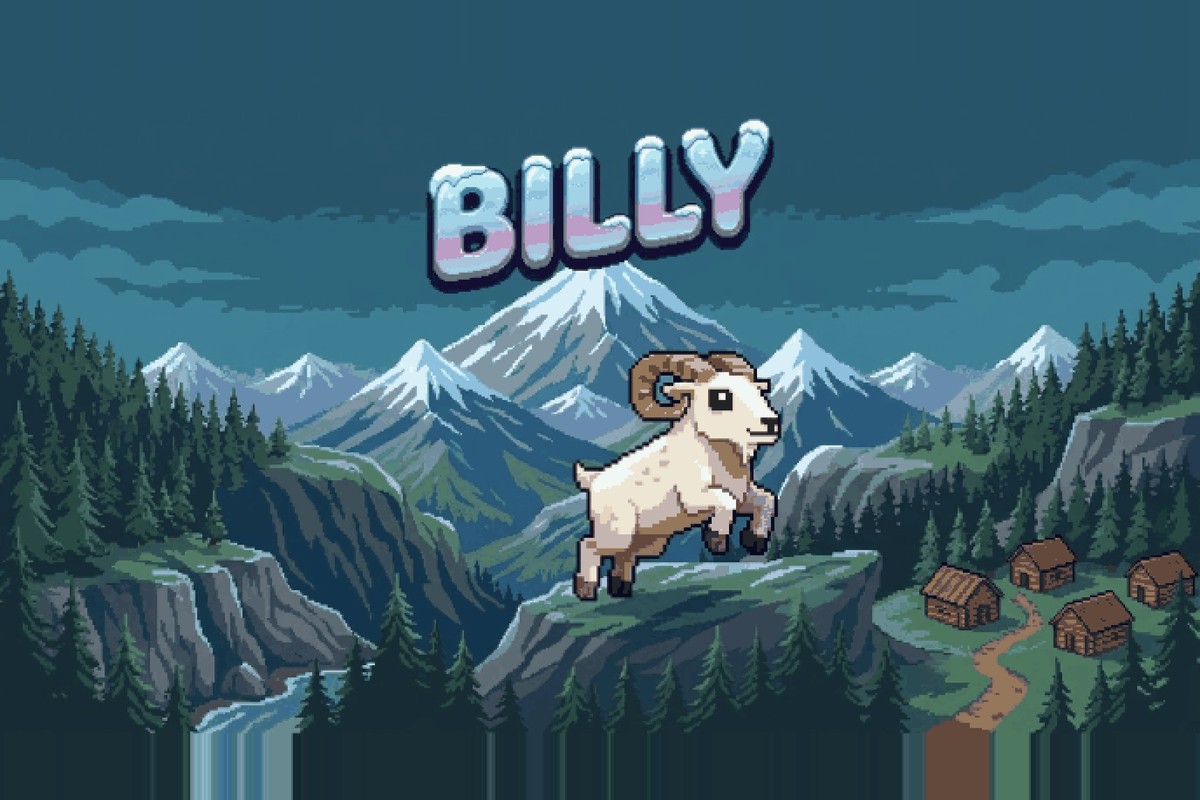
A vertical bouncer on a mountain with no top to it. Billy jumps by himself, at the
same height every time, so there is no jump button and nothing to charge: the only
thing you steer is where he is when he comes back down. Hold
← and →, or either side of the screen on a phone.
The ledges do the arguing. Some slide from side to side, some
crumble under a single landing, and the rare one throws you most of a
screen. The world wraps, so walking off one edge brings you back on the other and
the edge of the screen is a route rather than a wall — the eagles use it too.
Eagles end a run on contact, but come down on top of one and you stomp it, which
is a free bounce where there was no ledge at all. Underneath everything the floor is
rising and never stops, so standing still is never free. Height is the score, and the
two locked climbers each want a best climb and a number of eagles stomped.
Klondike, the solitaire everyone means by the word: seven columns, four
foundations and a stock to turn through. Build the columns down in alternating
colours, the foundations up by suit from the ace, and only a king
goes into an empty column. Tap a card to send it where it goes, drag it to choose,
double-tap to send it home.
Play draw one for the forgiving game or draw three for the one that
really loses. There is an undo, a hint that only ever suggests a move that gets
somewhere, a panel that tells you when a deal is genuinely stuck, and an
auto-finish once every card is face up. Your fastest solve is kept on your device.
Fill the grid so every row, column and 3×3 box holds 1 to 9 once each. Every
puzzle here has exactly one answer and none needs guessing: each is checked by a
solver before it is dealt, and graded by the hardest technique a person would need.
There is a Daily at three levels — Easy, Medium and Hard, the same three for
everyone each day — and free play deals a new one whenever you like.
Each Daily is against the clock: ten minutes for the Easy, twenty for the
Medium, thirty for the Hard, paused whenever you step away. Tap a square and a number,
or switch to pencil for small candidate marks (with All notes to fill them
in at once). Matching digits light up, a wrong digit shows in coral, and there's an
undo. Solve in time for the leaderboards — the fastest Daily at each level, and the
longest daily streak.
A meadow cut into camps: light one campfire in every row, every column and every
camp, with no two fires touching — not even at a corner. Every board has exactly one
answer and none needs guessing: each is proved by two separate solvers before it is
dealt, and graded by the hardest deduction a person would need. There is a Daily
at three levels — a 6×6 Easy, an 8×8 Medium and a 10×10 Hard, the same three for everyone
each day — and free play deals a new one whenever you like.
Each Daily is against the clock: five minutes for the Easy, ten for the Medium,
twenty for the Hard. Tap once for ash, twice for a fire; drag to ash a run of squares;
auto-ash marks what a fire rules out. Free play has three hints that point to the
next fire. Earn six skins and a set of badges by playing — never by paying.
Every tile carries a piece of telegraph wire, and every one has been spun. Tap to turn
them back a quarter at a time until one line runs from the office to every station — no
loops, nothing loose. Every board has exactly one answer and none needs guessing:
each is proved by two separate solvers before it is dealt. There is a Daily at three
levels — a 5×5 Easy, a 7×7 Medium and a 9×9 Hard, the same three for everyone each day — and
free play deals a new one whenever you like.
Each Daily is against the clock: four minutes for the Easy, eight for the Medium,
fifteen for the Hard. Every board has a par — the fewest turns that solve it — and
the best badges ask for a solve with no wasted turns. Hold a tile to pin it; free play has
three hints that point to the next tile. Earn six skins and a set of badges by playing —
never by paying.
An endless runner with two buttons: one to leave the ground, one to get flat. Your runner
never stops and never steers — jump what stands up out of the trail, duck what hangs across
it. The trail starts at a walk and builds to a sprint over the first twelve hundred metres;
past that the speed only creeps, but the gaps tighten and the mix turns meaner. Every gap
still leaves a real moment on the ground before the next jump, so a run ends on a read you
missed, never on a trail with no answer.
Pick your country on the way in. The Desert: graves, bones and saguaro to jump,
the gallows to duck, a tumbleweed that rolls at you, and light that goes from morning to a
night you can barely see in. The Forest: stumps, logs, a pond and a gap in the trail
to clear, and an eagle to duck. Same legs, same jump, same trail. Distance is the
score — there is nothing to collect and nothing to buy — and the furthest runs go on the
leaderboard.
A sliding-block escape puzzle in a six-by-six stockyard. Wagons, hay carts and ox teams
each roll only along their own track, and your red wagon is boxed in on the gate row. Shunt
the others out of the way until it can roll out through the open gate. One slide of one
piece is one move, however far it goes, and every yard has a par: the true
fewest moves out, found by searching every position the yard can reach and checked by a
second solver before it is dealt.
Finish at par for three stars. There is one Daily yard, a Medium, the same for
everyone, with no countdown: it is the moves that count. Free play has four levels, up to
Expert yards thirty-three moves deep or more, three hints a yard that point to the next
piece, and a Replay button to take the same yard down to par. Earn six skins and a set
of badges by playing — never by paying.
These are the games actually being built right now. None of them is playable here yet and
none of them has a date — when one is genuinely good it moves up into the list above and
gets a full guide of its own.
Westward — a trail-survival game about leading a wagon party west: hire your
people, stock the wagon within what your purse and your axles will bear, and take the
encounters as they come, one swipe at a time. Furthest along of the three, and currently
mid-rebuild — deck, towns, roster and economy all in flight at once.
Homesteader — an off-grid homestead sim in 3D: hire workers, lay out paths,
clear ground and grow a settlement from nothing. Bigger and slower than the games above;
it runs in the browser like everything else, but it's one you sit down with.
Remnant — stranded survival puzzles, atmospheric and story-driven: sixteen items
on screen, and you pick the exact four that solve the moment in front of you. The
earliest of the three and a long way from playable.
What they have in common
Nothing needs downloading, and nothing needs an account. Progress is saved in your
browser's own storage, on your device — which means it's private to you, and also that
clearing your browser data will clear it. Every game is built from scratch here: rules, art,
writing and code. If something's broken or you have an idea, the
contact page reaches us directly.